Wisdom Tree Yoga will be closing on March 30, 2026. Learn more below.
Autumn Yoga for Balance and Focus
Beverly Davis-Baird | NOV 3, 2024
vata
autumn yoga
ayurveda
ayurvedic living

Ayurveda teaches that each season carries its own energy, shaped by the three doshas—Pitta, Kapha, and Vata. As autumn arrives, Vata takes the lead, bringing qualities of coolness, dryness, and constant change. When left unchecked, these energies can leave us feeling scattered, restless, or depleted. The good news is that by aligning your daily routines and yoga practice with the rhythm of the season, you can nurture steadiness, warmth, and clarity.
In this blog, you’ll discover simple autumn guidelines inspired by Ayurveda, along with yoga practices that help pacify Vata—think grounding, warming, and calming poses designed to bring balance back to body and mind.

Understanding the Seasons and Doshas
Rather than segmenting the year into winter, spring, summer, and fall, Ayurveda divides the year into three seasons: Kapha season, Pitta season, and Vata season.
According to Ayurveda, the latter half of winter into spring is Kapha season. Composed of the elements of water and earth, Kapha qualities are cold, moist, heavy, dull, static, smooth, dense, oily, and soft, sweet, sour, and salty in taste.
Next comes Pitta season. Pitta consists of the elements of fire and water. It is characterized as being oily, sharp, hot, light, fleshy, spreading, and liquid, and salty, sour, and pungent in taste. The energy of pitta is strongest from late spring to early fall.
In contrast to the hot, sharp, oiliness of Pitta is the airy, spaciousness of Vata. Autumn and early winter are Vata season. Vata is characterized by the qualities of dryness, roughness, windiness, unpredictability, coolness, subtlety, and clarity. These qualities can leave you feeling agitated, restless, and unsettled.
To reduce Vata and counteract its qualities, Ayurveda recommends adding practices that enhance the qualities of Pitta and Kapha into your daily routine and yoga practice. In other words, practices for bringing more moisture, warmth, and calming energy into our daily routines.
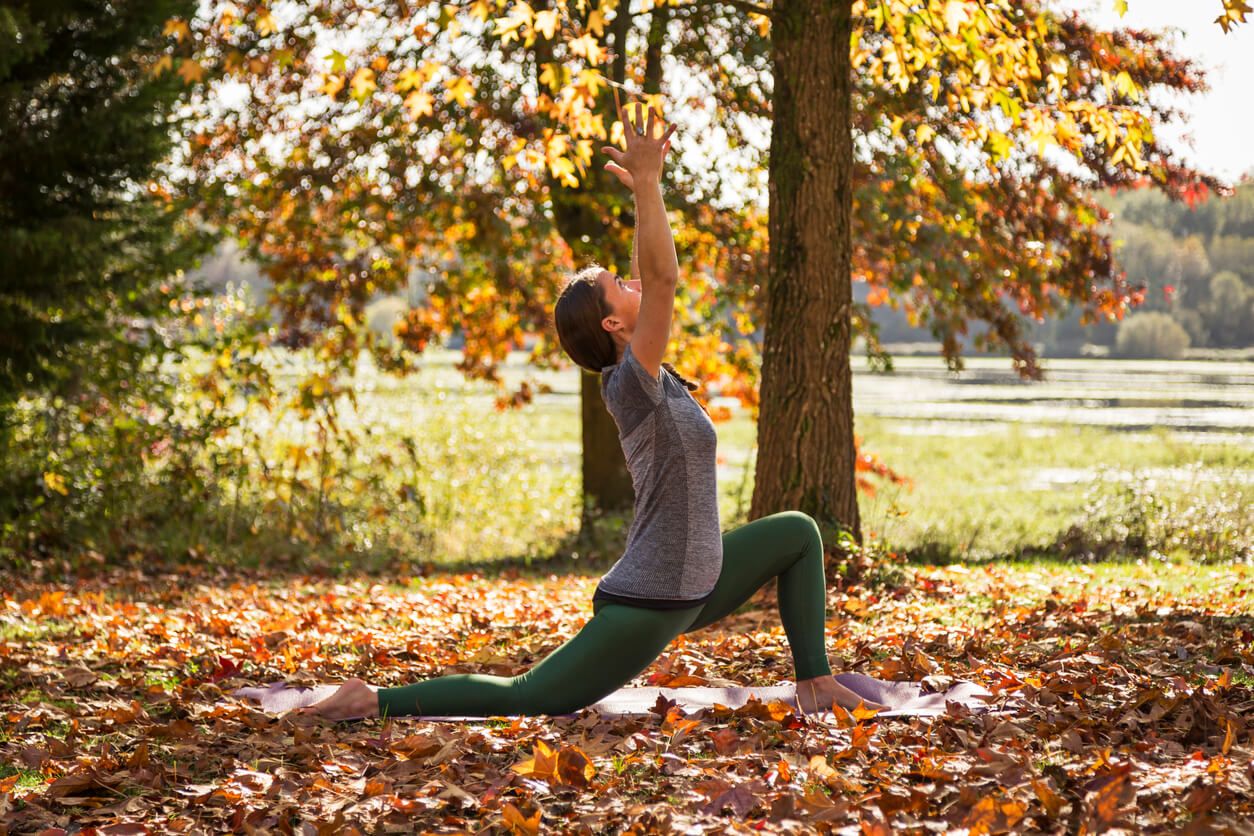
Autumn Yoga Practice Guidelines
Vata is very easily aggravated by fast, mobile activities, which can be depleting. To counteract this, autumn is a time to favor slow, mindful forms of yoga, which are less draining. Slow vinyasa or gentle restorative practices are best suited to harmonizing Vata’s erratic energy.
Begin your yoga practice by warming up slowly. Move with intention and fluidity, focusing on neck rolls and joint rotations. Then, as you move through your practice, strive to hold each posture for a short amount of time (5 breaths or so). Aim to do multiple repetitions of each asana to get its full benefit.
Keep your breath deep and calm. Ujjayi (Victory breath) is an effective means of achieving this. It also has the benefit of being a warming breath. Conclude your practice with a balancing pranayama like Nadi Shodhana, or alternate nostril breathing, which has a steadying effect on Vata.
Finally, less is more! Vata types can exhaust themselves, so exercise at about fifty to seventy percent of your capacity, breathing through your nose the entire time.
Vata-Pacifying Yoga Poses
Create your own fall yoga sequence using these suggestions as a guide. Remember: even if you can only commit to five minutes a day, a regular, consistent yoga practice is key to staying grounded and balanced during the cooler, drier autumn.

Soothing Seated Poses
To increase calm and keep busy minds and bodies still, practice seated poses, such as Easy Pose (Sukhasana), Hero Pose (Virasana), Head to Knee Pose (Janu Sirsasana), and Lion Pose (Simhasana).
Stabilizing Standing Poses
Balancing and standing poses help stabilize both body and mind, reducing anxiety and nervousness. Include poses that increase stability and strength, like Tree Pose (Vrksasana), Mountain (Tadasana), Triangle (Trikonasana), and Warrior II (Virabhadrasana II). Focus on the foundation of the pose for stability, grounding through the big toes, and the sides of the feet.

Grounding Forward Bends
Practice forward bends to quiet the mind, connect with the earth, and give immediate relief for excess Vata. Poses such as Child's Pose (Bālāsana), Standing Forward Bend (Uttanasana), and Seated Forward Bend (Pashchimottanasana) are good for tight lower backs and stiff spines. Try doing a 10-minute forward bend before bedtime to calm your body and mind and reduce insomnia.
Balancing Backbends
To balance the effect of forward bends, incorporate a few gentle backbends. Prone backbends, such as Cobra (Bhujangasana), Locust (Salabhasana), and Bow Pose (Dhanurasana), have the added advantage of being grounding, too.

Twists to Support Digestion
Spinal twists, especially when done lying or seated, reduce Vata in the nervous system and aid digestion. Examples of these include Reclined Twist (Jathara Parivartanasana), Half Lord of the Fishes (Ardha Matsyendrasana), and Twisting Chair Pose (Parivrtta Utkatasana). To reduce constipation and gas, incorporate poses such as Sphinx Pose (Salamba Bhujangasana) and Cat-Cow (Marjaryasana-Bitilasana), which gently compress the belly.
Rest and Restore
Equally soothing are gentle inversions and restorative poses, such as Legs-up-the-Wall (Viparita Karani) or Mountain Brook Pose (Salamba Matsyasana). And be sure not to skip Savasana! End your practice with a cozy, 20-minute Savasana or yoga nidra. To maximize relaxation and avoid becoming chilled, use an eye pillow and cover yourself with a warm blanket.
When we align our yoga practice with the natural rhythm of the seasons, we give ourselves the gift of steadiness, energy, and ease. This fall, I invite you to explore how simple practices can help you feel more grounded by visiting my blog, "6 Ways to Balance Vata Season with Ayurveda + Yoga."
Be well!
published 10/11/20; updated 9/1/25
_______________________________________
Wisdom Tree Yoga’s goal is to share the transformative benefits of yoga with real people living with real-life challenges. We welcome students of all levels, offering a safe, supportive environment that is inclusive, accessible, compassionate, and joyful. Join me, follow me, and stay in touch with me by clicking HERE.
Beverly Davis-Baird | NOV 3, 2024
Share this blog post

CONTACT
© 2026 Wisdom Tree Yoga & Healing Arts, LLC